





WONDERLAB and Shandong University Announce a Joint Laboratory for Targeted Gut Microbiota and Metabolic Health in Partnership with a State Key Laboratory
2025-12-05
The First Conference on Microbiology Discipline Development and Industry–Education Integration was held successfully in Qingdao on October 18–19. As a major commemorative event marking the 30th anniversary of the opening and operation of Shandong University’s State Key Laboratory of Microbial Technology and the 75th anniversary of the establishment of its microbiology discipline, the conference also saw the official announcement of a series of the laboratory’s upcoming key research projects.
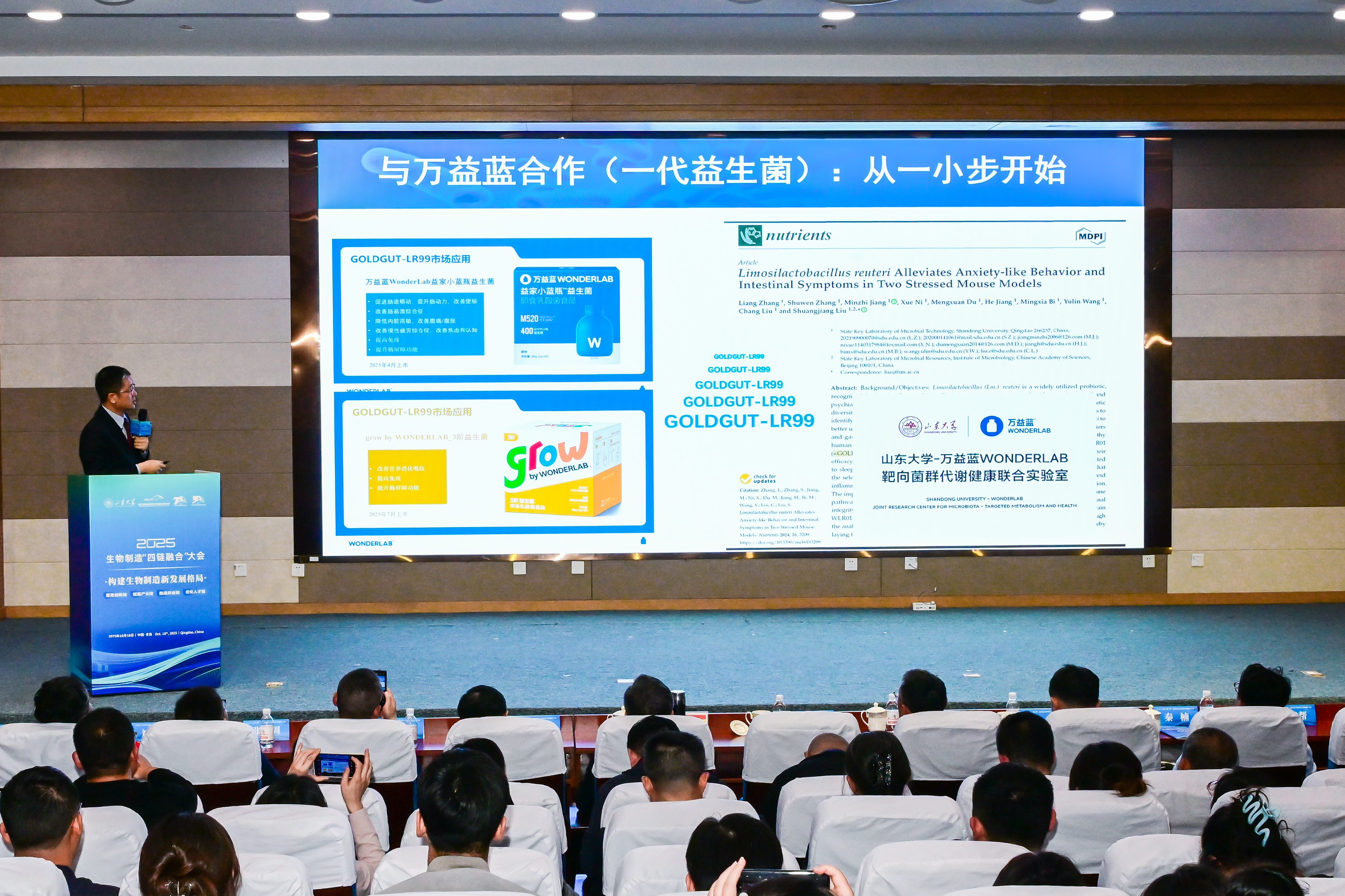
At the conference, Professor Shuangjiang Liu—a specially appointed professor at Shandong University, a research professor at the Institute of Microbiology, Chinese Academy of Sciences, and president of the Gut Microbiota Branch of the Chinese Biophysical Society—signed a cooperation agreement with WONDERLAB. The parties formally announced the establishment of the Shandong University–WONDERLAB Joint Laboratory for Targeted Gut Microbiota and Metabolic Health. This cooperation represents another important strategic step for WONDERLAB in targeted-gut-microbiota research. Going forward, WONDERLAB will continue to integrate leading research resources and deepen the exploration and application of core technologies for targeted gut microbiota.

Deep Industry–Academia–Research Integration to Advance Core Technologies for Targeted Gut Microbiota
The cooperation between WONDERLAB and Shandong University’s State Key Laboratory of Microbial Technology represents a high-level alignment between frontier industry insight and national-level research strength. Drawing on Shandong University’s deep expertise in gut microbiome research, the joint laboratory will focus on the core direction of “targeted gut microbiota and metabolic health.” It will conduct in-depth research on frontier topics including “probiotic regulation of human glucose metabolism” and “probiotic prevention of weight regain after weight loss,” moving beyond the previous focus of much probiotic research on lipid metabolism and further expanding the scientific boundaries of targeted-gut-microbiota research.
The gut microbiome research team at Shandong University’s State Key Laboratory of Microbial Technology has achieved fruitful results in gut microbial-resource discovery, omics research, functional-strain development, and mechanistic analysis. Using culturomics, the team has isolated and cultured more than 1,000 types of gut microorganisms and built a systematic resource bank of gut microbial strains. Its innovative research findings have been published in international journals including Nature Microbiology and Science China (English edition), providing full-chain research support for targeted-gut-microbiota research, from strain screening to functional-mechanism analysis.

The core proprietary strain developed through this cooperation, Limosilactobacillus reuteri GOLDGUT-LR99, has been among the first to achieve commercial-scale application. It has been successfully used in several products, including WONDERLAB All-in-One Probiotics 4.0 and grow by WONDERLAB Probiotics for Kids. This strain is a representative outcome of the team’s research into gut-microbiota functions. Clinical studies have shown that it can significantly promote intestinal motility and improve gut-barrier function, with demonstrated effects in improving irritable bowel syndrome and reducing visceral hypersensitivity.
In his keynote presentation at the conference, Professor Liu emphasized that the R&D and application of GOLDGUT-LR99 have established a complete innovation chain spanning basic research, clinical validation, and industrial translation, setting an evidence-based example for probiotic-function research.
Strengthening the Targeted-Gut-Microbiota R&D Platform Through High-Level Industry–Academia–Research Collaboration
As a leading company in targeted-gut-microbiota research, WONDERLAB has consistently made core technology leadership its foundation and deepened collaborative innovation with key research universities. It has previously established close cooperation with national-level research teams at higher-education institutions including Shenzhen University and Hainan University. Focusing on the core pathway of “targeted strain screening—functional-mechanism analysis—precision product development,” WONDERLAB is continuing to strengthen full-chain support for targeted-gut-microbiota R&D, building a research platform that covers the entire R&D process and actively advancing innovative studies on strain-function development.
The cooperation with Shandong University is a key extension of WONDERLAB’s industry–academia–research system. Through an “academic research–industrial practice” closed loop, it further reinforces the full-chain technical foundation from strain screening and functional validation to product translation, while accelerating the commercialization of core technologies and improving the credibility and translation efficiency of research outcomes. At the same time, through this cooperation, WONDERLAB will further focus on the core mechanisms linking targeted gut microbiota with metabolic health and expand the boundaries of research. By combining the depth of basic research with the efficiency of industrial translation, it aims to set dual benchmarks for the industry; through evidence-based outcomes, it will also move beyond the barrier of “concept marketing” and help guide the probiotic industry toward high-quality development driven by technology and supported by verifiable benefits.

In the future, WONDERLAB will continue to use the highest scientific and evidence-based standards of the global probiotic industry as its benchmark. Working with Shandong University and other leading research teams worldwide, it will develop more probiotic products with targeted value, actively participate in and advance scientific standards and standardization in China’s probiotic industry, and drive industry innovation and high-quality development through robust scientific evidence, contributing its core capabilities to public health.