






WONDERLAB Makes a Strong Showing at the 2026 China Gut Health and Innovation Conference, Advancing Evidence-Based Microbiome Health Across the Life Course
2026-05-30
From May 29 to 31, 2026, the 2026 China Gut Health and Innovation Conference, jointly organized by the Gut Microbiota Branch of the Chinese Biophysical Society and the Guangdong 21st Century Education Foundation, was successfully held in Shanghai. As a leading biotechnology company in the microbiome field, WONDERLAB hosted the session “The Life-Course Microbiome and Gut–Brain Axis: Innovative Applications of WONDERLAB Microbiome and Precision Nutrition Interventions.” Grounded in scientific advances in gut–brain-axis mechanisms, the session explored new directions for precision microbiome interventions through targeted microbiota regulation together with leading experts in attendance.
The session was chaired by Professor Chenhong Zhang of the National Key Laboratory of Microbial Metabolism at Shanghai Jiao Tong University. Professor Shuangjiang Liu, Chair of the Gut Microbiota Branch of the Chinese Biophysical Society and of the National Key Laboratory of Microbial Engineering Technology at Shandong University; Professor Zhigang Liu of the Institute of Nutrition at Fudan University; Professor Jie Mi of the National Center for Children’s Health and the Children’s Hospital affiliated with Capital Medical University; Professor Zhongze Fang, Secretary-General of the Gut Microbiota Branch of the Chinese Biophysical Society and Executive Chair of the China Obesity Alliance; and other leading experts attended the session. From basic research to clinical applications, they discussed the central role of the gut microbiome in life-course health management. They also presented a range of industry–academia–research collaboration outcomes involving WONDERLAB in the microbiome field, contributing to the high-quality development of microbiome science and its application in public health.

Decoding Bidirectional Gut–Brain Communication: Homegrown Strains Build Multidimensional Barriers for Emotional and Gut Health
The bidirectional communication network between the gut and the brain is reshaping our understanding of the relationship between emotional health and gut function. At the session, experts systematically outlined the scientific pathway from strain-resource discovery and metabolic-pathway analysis to regulation of the nervous system, revealing how this core regulatory network can be discovered and validated and providing a scientific foundation for precision microbiome interventions.
Professor Shuangjiang Liu shared his team’s latest findings on the exploration of intestinal strain resources, with a particular focus on the role of species in the genus Alistipes in Alzheimer’s disease. He highlighted the scientific pathway of WONDERLAB’s core patented strain, Limosilactobacillus reuteri GOLDGUT-LR99, from resource discovery to functional validation. According to Professor Liu, the strain was isolated and selected strictly from the intestinal tract of healthy individuals. Among 12 strains in the same genus, it demonstrated three distinctive advantages: the fastest growth, exceptional gastric-acid tolerance, and the highest butyrate production; it was also the only strain capable of producing isovaleric acid. The discovery and functional validation of this strain provide new molecular targets and intervention tools for understanding gut–brain-axis interactions.
Professor Liu further noted that the value of GOLDGUT-LR99 extends beyond its basic characteristics, with potential for targeted intervention in gut–brain-axis regulation. Animal studies showed that the strain significantly alleviated anxiety-like behaviors in mice exposed to water-avoidance stress and sleep deprivation, while improving slow weight gain, accelerated intestinal motility, and visceral hypersensitivity. Its proposed mechanism involves suppressing excessive activation of the hypothalamic–pituitary–adrenal axis (HPA axis), restoring intestinal-barrier integrity, and reducing systemic inflammation and oxidative stress. Further research has reported clear effects in improving irritable bowel syndrome and reducing visceral hypersensitivity, supported by molecular-target and signaling-pathway evidence for its anti-inflammatory activity and intestinal-barrier repair function.

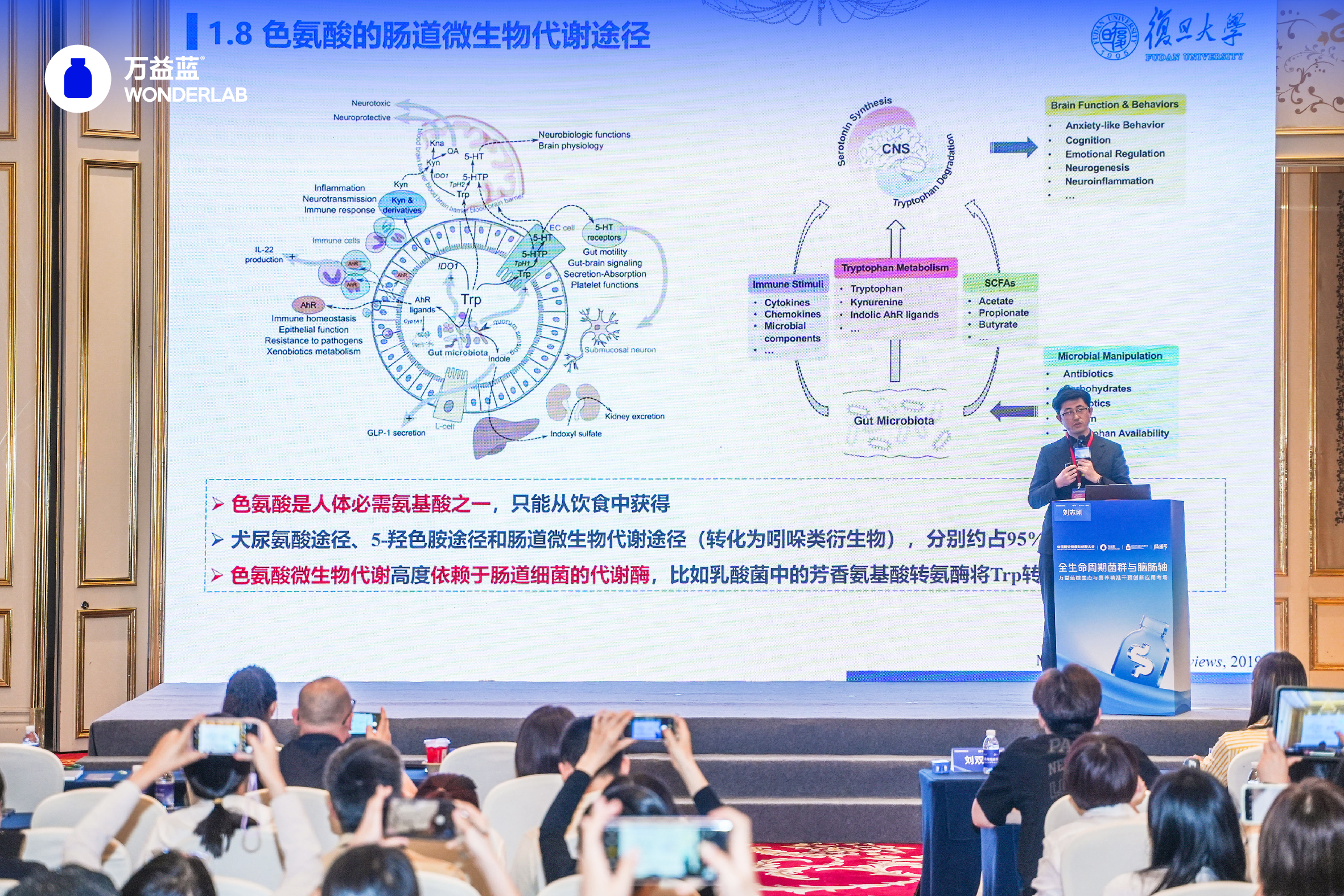
In his presentation, Professor Zhigang Liu focused on the critical window of early-life neural development. From the perspective of microbial metabolic regulation, he described the importance of targeting the tryptophan metabolic pathway in nervous-system development, extending gut–brain-axis research through a new metabolite-mediated perspective. Together, the two experts provided evidence from different dimensions for the importance of the “gut microbiota–metabolites–nervous system” pathway in health interventions.
Reframing the Foundations of Weight Management: Targeted Microbiota Regulation Enables Innovation in Metabolic Intervention
As the scientific mechanisms of the gut–brain axis become clearer, translating cutting-edge research into systematic and practical precision-intervention solutions has become the central challenge in moving from basic research to application. During the roundtable “Targeted Microbiota Weight Management: After Years of Self-Discipline, Where Is the Body Stuck?”, participating experts examined modern weight health through the lens of the gut microbiome.
WONDERLAB’s previously released White Paper on Targeted Microbiota Weight Management systematically maps the technical pathway from gut–brain-axis research to targeted microbiota intervention. It also introduces the Mayo Clinic’s obesity pathophysiology phenotyping framework and identifies gut-microbiota dysbiosis characteristics associated with different obesity phenotypes, providing the industry with a more precise, evidence-based reference for weight management.
At the meeting, Professor Shuangjiang Liu cited extensive research data indicating a clear causal relationship between the gut microbiota and weight regulation. Excessive growth of harmful microbiota may trigger chronic low-grade intestinal inflammation, thereby promoting fat accumulation and obesity; beneficial bacteria may competitively inhibit harmful bacteria and regulate glucose and lipid metabolism through their metabolites, helping maintain a healthy weight. Professor Zhongze Fang noted that obesity is a chronic disease driven by multiple factors and involving complex pathological mechanisms. All possible approaches, including probiotics, should be explored with an open mind as researchers investigate the role of gut-microbiota interventions in weight management. From the frontier of metabolic regulation, Professor Chenhong Zhang explained the value of microbiome interventions. She noted that weight regain after GLP-1 agonist intervention is, to a considerable extent, associated with changes in gut-microbiota structure. Although pharmacological intervention can produce rapid results, long-term metabolic health requires comprehensive management, and maintaining a healthy gut microbiota is key to sustainable weight management.

As a representative application of the Targeted Microbiota Management Method moving from theory to products, WONDERLAB’s new EASY 100 PRO™ probiotic, featuring WONDERLAB’s self-developed patented strains, was recently launched to provide an accessible targeted solution for people who experience emotional eating.
Supporting Growth and Development Across the Life Course Through Precision Microbiome and Targeted Nutrition Interventions
As gut–brain-axis research continues to advance, the effects of the gut microbiome on health have been shown to extend across the complete life course, from early life to old age. WONDERLAB has consistently made “life-course microbiome health management” a core development focus, translating leading scientific findings into precision nutrition products for people of different ages. Its children’s nutrition brand, grow by WONDERLAB, has built a precision nutrition system based on children’s growth rhythms and stage-specific differences, characterized by age-based precision, scenario-specific targeting, and nutritional synergy. The brand has developed a range of innovative solutions, including age-stage probiotics for children and Mengzhang No. 1™ Liquid Calcium.
At the conference, Professor Jie Mi focused on childhood and adolescence as a critical “window of opportunity” for growth. He noted that children in China face several less visible challenges, including bone-mineral accumulation lagging behind height growth, accelerated axial elongation associated with earlier myopia onset, nutritional imbalance during the final window for catch-up growth, and metabolic abnormalities arising from disrupted sleep rhythms. Traditional single-nutrient supplementation can no longer fully meet the needs of children’s comprehensive development. Industry stakeholders need to build multidimensional, precise, and integrated nutrition-intervention systems based on the development of body composition.
Professor Mi emphasized: “The development of children’s nutrition products cannot be separated from the overall framework of growth and development; it must return to scientific evidence and real health needs.”

As Professor Chenhong Zhang said in her address, “The life-course microbiome and the gut–brain axis are not only central areas of frontier exploration in science, but also important practical avenues for responding to the Healthy China strategy and serving the health of the whole population.”

At the opening of the 15th Five-Year Plan period, 2026 has been identified as a year in which innovation in health products will serve as an important lever for upgrading consumption. Scientific innovation in the microbiome field is entering an unprecedented period of opportunity. WONDERLAB will continue to ground its work in evidence-based science, deepen industry–academia–research collaboration, advance the high-quality development of the sector, and contribute WONDERLAB’s capabilities to life-course gut health management for the public.